

Bucket List / Adventure Travel Goals
Climb Mt Kilimanjaro, Summit Of Africa
Ticked off in October 2008
Walk from rainforest to glacier in a week and watch the sun rise over Africa from its highest point.
The adventure
Kilimanjaro rises alone out of the East African plains, a snow-capped volcano standing almost 5 kilometres above the land around it, and climbing it is like walking from the equator to the Arctic in a week. You start in rainforest alive with colobus monkeys, climb through heather and moorland dotted with giant groundsels, then cross a high alpine desert of rock and dust towards the great dome of Kibo.
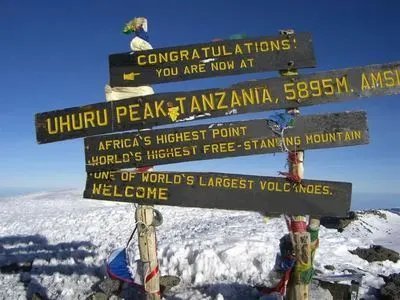
On routes like Machame and Lemosho, you scramble up the Barranco Wall and sleep beneath skies crowded with stars. Summit night begins around midnight, with hours of slow, breathless switchbacks by head torch. Somewhere near Stella Point the sky turns orange, the glaciers glow pink and the clouds spread out far below you. A last push around the crater rim brings you to Uhuru Peak at 5,895 metres, the roof of Africa.
Why it’s epic
- Standing on Uhuru Peak at 5,895 metres, the highest point in Africa and one of the Seven Summits.
- Passing through five climate zones, from rainforest to arctic summit.
- The highest free-standing mountain in the world, with no technical climbing needed.
- Sunrise over the crater rim and the summit glaciers.
What it is
At 5,895 metres, Kilimanjaro is the highest mountain in Africa.
How to do it
Book with a licensed operator. The Lemosho and Machame routes give the best acclimatisation.
Top tip
Choose a longer route; success rates are much higher.
Need to know
- You must climb with a licensed guide, and park fees are charged per day, so longer routes cost more but succeed far more often.
- Choose a route of at least seven days, such as Lemosho or Machame, for better acclimatisation.
- January to March and June to October are the driest months; April and May bring the long rains.
- Insurance must cover trekking to 6,000 metres and evacuation.
Plan this trip
- Rough cost
- £2,000 to £5,000 per person, including flights from the UK
- Time needed
- 6 to 9 days
- Best time to go
- January to March, June to October
- Fly into
- JRO airport
Daily park fees, a crew of guides, porters and cooks, and tips make up most of the cost.
Sample itinerary
- Day 1Land at Kilimanjaro airport (JRO) and transfer to Moshi for a kit check and briefing
- Days 2–7Climb the Machame or Lemosho route through rainforest, moorland and alpine desert, with an acclimatisation day
- Day 8Midnight start for Uhuru Peak at sunrise, then descend to the last camp
- Day 9Walk out to the gate, collect your certificate and celebrate in Moshi
- Days 10–12 (optional)Safari in Tarangire or Ngorongoro, or a few days on Zanzibar
Do it yourself
- Small-group adventuresMuch Better AdventuresActive small-group trips run by local experts.
- Tours and ticketsGetYourGuide
- FlightsKiwi.com
Some of these are affiliate links: if you book through them I may earn a small commission, at no extra cost to you. More about this.
Kit I'd pack
Porters carry the big bag, so your daypack and the kit for summit night are what matter.
- Trekking polesAmazonYour knees will thank you on the way down.
- 4-season sleeping bagAmazonNights at high camp drop well below freezing.
- Rechargeable head torchAmazonSummit night starts around midnight.
- 3L water bladderAmazonDrinking lots helps with altitude, and sipping on the move is easiest.
- GaitersAmazonKeeps the volcanic scree out of your boots.
As an Amazon Associate I earn from qualifying purchases, at no extra cost to you. More of my travel kit.
My experience
Ticked off, but the full story is still to be written up.
Comments