
Climb The Dunes At Sossusvlei
Still to do
Climb a red dune more than 300 metres high at sunrise, then run down into a white pan of ancient dead trees.
The adventure
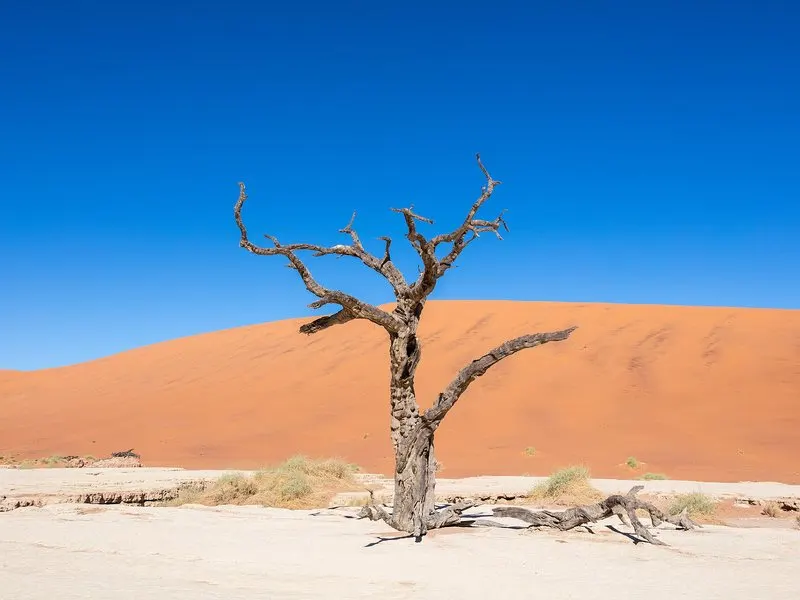
At sunrise the dunes glow. Light catches one face and turns it fiery orange while the other stays in deep shadow, and the sharp ridge between them leads up and up towards the top of Big Daddy, at around 325 metres one of the tallest dunes in the area.
The climb along the crest is slow and hot, every step sliding back a little. But from the top you can see across a sea of dunes in every direction, and straight down to Deadvlei, a white clay pan dotted with black, dead camelthorn trees. They died around 600 to 700 years ago when the river that fed them was cut off, and in the dry air they've never rotted. Then you run straight down the dune face into the pan in a few giddy minutes.
Why it’s epic
- Big Daddy, one of the tallest dunes in the Namib.
- Deadvlei's dead camelthorn trees, around 600 to 700 years old.
- Dune 45, the easier, classic sunrise climb.
What it is
Sossusvlei is a clay pan surrounded by some of the tallest sand dunes in the world, in the Namib, often called the world's oldest desert. Nearby Deadvlei is a white pan dotted with dead camelthorn trees hundreds of years old.
How to do it
Stay at Sesriem, just outside the park gate, so you can drive in at sunrise. Climb Big Daddy or Dune 45, then walk to Deadvlei.
Top tip
Be at the gate when it opens: the dunes are at their reddest and the sand is coolest early on.
Need to know
- The last stretch to Sossusvlei needs a 4x4 or the park shuttle.
- Take lots of water; temperatures soar by midday.
- Accommodation inside the park gate gets you in earliest.
Plan this trip
- Rough cost
- £2,000 to £5,000 per person, including flights from the UK
- Time needed
- A day
- Best time to go
- May to October
- Fly into
- WDH airport
Car hire and lodges in Namibia add up; park fees are low.
Make it happen
Why it’s on my list
Not done yet. If you’ve done it and have tips, tell me about it.
Comments