

Learn To Skydive
Ticked off
Go from clinging to two instructors on your first jump to leaping out alone and flying your own body through the sky.
The adventure
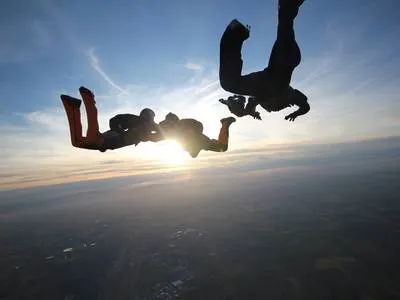
On your first AFF jump, two instructors hold onto your harness as you sit in the open door at around 13,000 feet, the wind roaring and the ground a map far below. Check in, look up, and go. Then comes about a minute of freefall at roughly 120 mph, the air so dense you can lean on it, while you work through your drills, check your altitude and pull your own parachute.
Each level takes something away. One instructor lets go, then the other; you learn to turn, to move forward, to recover from a tumble and, finally, to leave the plane entirely on your own. Under canopy it goes quiet, and you steer yourself down to the landing area. Pass the course, keep jumping, and the whole world opens up, from formation skydives with friends to drop zones above Spanish coastline and Alpine valleys.
Why it’s epic
- AFF puts you in freefall on your very first jump, with two instructors holding on.
- Freefall from around 13,000 feet lasts about a minute, at roughly 120 mph.
- After passing AFF, around 25 jumps earns a USPA A licence, recognised at drop zones worldwide.
- A licence lets you jump at drop zones around the world, from Spain to Dubai and Australia.
What it is
Learning to skydive means earning a licence to jump solo.
How to do it
Take an AFF course at a licensed drop zone.
Top tip
Warm, sunny places like Spain make for faster progress.
Need to know
- Weather is the biggest delay, so many people train in sunny places such as Spain, where courses can be finished in a week or two.
- You'll need to complete a medical declaration, and some people need a doctor to sign it.
- Ground school covers emergency procedures thoroughly before you jump, and you'll repeat any level you don't pass.
- Make sure your travel insurance covers skydiving if you train abroad.
Do it yourself
Kit I'd pack
The drop zone provides the rig, helmet and jumpsuit while you train. A couple of things are worth having of your own.
- Skydiving logbookAmazonEvery jump gets signed off. You'll need it to progress.
- GoProAmazonFor later: you need a C licence (around 200 jumps) before you can jump with a camera.
As an Amazon Associate I earn from qualifying purchases, at no extra cost to you. More of my travel kit.
How I ticked it off
I know this is guaranteed not to be something everyone has on a bucket list, for most, just completing a skydive is enough, and I totally get that, but I am after all, an adrenaline junkie!
I did my first skydive in Wollongong, near Sydney, Australia in 2013 – it was a memorable incredible experience that stuck with me, at the time I vowed to get my license!
Alas, it didn’t happen, I did another skydive in Los Angeles, USA in 2014 – where I bought my sister the jump as a present (some might call that cruel!) and another jump in Rio De Janeiro, Brazil in 2016. Every time the rush is immense, the feeling of freefall is amazing!
Getting a licence is not actually that difficult, you sign up to an AFF course, pass some tests and then you can jump anywhere in the world!
I want that freedom, to strap on a chute and get the best views anywhere in the world! What a rush!
Day 1 (Friday night). Arrive. Meet other jumpers. everyone else has jumped before. Recieve the bad news that jump master Keith, plane cancelled due to Storm Callum. Dissapointing, was meant to be ground school on day 2.
Day 2 (Saturday). Head in to DZ to get a feel for the place, great bunch, people showing us around, basics, fill in forms, watch as many landings, start learning drills.
Day 3 (Sunday). Ground school – spread across the day as bad weather
Day 4 (Monday). Wait around all day for good weather, finally get a jump in! woo. Level one is with 2 instructors.
Day 5 (Tuesday). Rain, clouds, wind
Day 6 (Wednesday). Level 2,3,4
Day 7 (Thursday). Rain
Day 8 (Friday). Level 5,6,7
Day 9 (Saturday). Torrential Rain.
Skydiving licences explained
Passing AFF isn't the finish line, it's the start. Licences are graded A to D, and each one unlocks more. In the UK they're issued by British Skydiving. Most drop zones abroad, including a lot of the Spanish ones, use the American USPA licences instead. The jump numbers are a little different, but the ladder is the same.
| Licence | British Skydiving (UK) | USPA | What it lets you do |
|---|---|---|---|
| A | Around 18 jumps: AFF or static line, the consolidation jumps and a written exam | 25 jumps | Jump solo without an instructor, and start doing simple two-way jumps with a qualified coach. You're still a beginner, so drop zones keep a close eye on you. |
| B | 50 jumps, plus canopy and jumpmaster training | 50 jumps and 30 minutes of freefall | Group formation skydives, acting as jumpmaster, and the first coaching and instructor courses. USPA adds night jumps and hot-air-balloon jumps. |
| C | 200 jumps, more canopy training and a written exam | 200 jumps and 60 minutes of freefall | Jumping with a camera, bigger formations, and specialist disciplines like wingsuiting once you have the other qualifications. |
| D | 1,000 jumps | 500 jumps and 3 hours of freefall | The top licence: display and demo jumps, canopy piloting competitions and the senior instructor ratings. |
When can you jump with a camera?
Not until you've got around 200 jumps. British Skydiving treats a C licence as the minimum to jump with a camera, and you'll also need a camera briefing from the drop zone before your first camera jump. USPA recommends the same 200 jumps. Even a little GoPro on your helmet is a distraction and a snag risk when things go wrong, so the rule makes sense. Until then, the drop zone's camera flyers will film you for a fee.
Rules change and drop zones can add their own, so check with your instructors before you jump.
Comments