

Bucket List / Experience Goals
Visit A Bioluminescent Beach
Ticked off in 2020
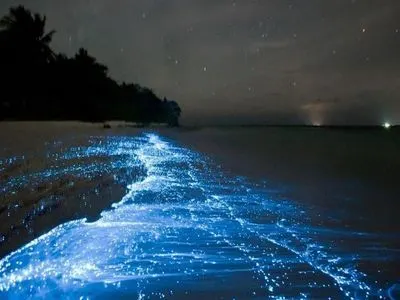
Trail your hand through black water and watch it burst into blue sparks like stars under the surface.
The adventure
You paddle out after dark, the shoreline disappearing behind you and the sky thick with stars. At first the water looks ordinary. Then your paddle dips in and the blade lights up an eerie electric blue, and a trail of glowing swirls spins away behind the kayak.
Every movement sets it off. Fish dart beneath you as streaks of light, and water dripping from your fingers falls like glowing sparks. On some beaches, waves break in lines of neon blue and footprints in wet sand flash as you walk. The light comes from billions of tiny single-celled plankton called dinoflagellates, each one giving off a flash when disturbed. In a few places, sheltered bays with narrow entrances and mangroves trap them in such numbers that the whole bay seems to glow.
Why it’s epic
- Mosquito Bay on Vieques, Puerto Rico, was named the brightest bioluminescent bay in the world by Guinness World Records.
- Puerto Rico has three bioluminescent bays, including Laguna Grande in Fajardo and La Parguera in the south-west.
- Vaadhoo in the Maldives is famous for its "sea of stars" glowing shoreline.
- The glow is a chemical reaction, a defence mechanism that startles predators.
What it is
Bioluminescent plankton glow blue when the water is disturbed.
How to do it
Kayak tours in Puerto Rico's Mosquito Bay are among the brightest.
Top tip
Go on a moonless night.
Need to know
- Go on a dark night near the new moon, as moonlight and city light wash out the glow.
- Swimming is banned in some bays, including Mosquito Bay, to protect the organisms, so book a kayak or electric boat tour.
- Skip sunscreen and insect repellent before getting in the water, as chemicals can harm the plankton.
Do it yourself
Some of these are affiliate links: if you book through them I may earn a small commission, at no extra cost to you. More about this.
My experience
The stunning phenomenon of bio luminescent beaches is actually a chemical reaction that allows living creatures to produce light.
The glittering critters were dinoflagellates, a phytoplankton species found across the world’s oceans. These tiny organisms emit light to startle predators and, some scientists think, to draw the attention of other creatures that eat the original predators. In high concentrations, flashing dinoflagellates can make the water glow.
Comments