
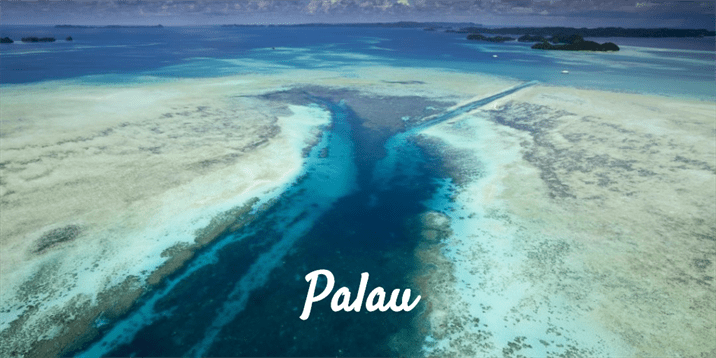
 Palau
Palau
Not been yet
At a glance
- Region
- Micronesia
- Capital
- Ngerulmud
- Population
- 18,000 (2024)
- Area
- 459 km²
- Languages
- English, Palauan
- Currency
- United States dollar (USD)
- Drives on the
- right
- Calling code
- +680
Visited Still to go Click a pin or country to read more. Zoom with + and −, a double-click or a pinch.
Before you go
Overview
Palau, (also spelled Belau or Pelew) is a country in the western Pacific Ocean. It consists of some 340 coral and volcanic islands perched on the Kyushu-Palau Ridge.
The Palau archipelago lies in the southwest corner of Micronesia, with Guam 830 miles (1,330 km) to the northeast, New Guinea 400 miles (650 km) to the south, and the Philippines 550 miles (890 km) to the west.

The Rock Islands
A huge barrier reef system, continuous on the west and broken on the east, encircles most of the archipelago. Its major populated islands are Babelthuap (Babeldaob), Koror, Malakal, Arakabesan, and Peleliu. The sparsely populated Kayangel Islands to the north of Babelthuap and the raised coral islands of Angaur, Sonsorol, Pulo Anna, and Tobi south of Peleliu lie outside the barrier reef system.
Palau was a member of the UN Trust Territory of the Pacific Islands, which was established in 1947 and administered by the United States. The U.S. government dissolved the trusteeship in 1986, but repeated measures to win the required support for a compact of free association between Palau and the United States were unsuccessful until 1993. The Republic of Palau officially became a sovereign state on October 1, 1994.
Koror island, rising to 2,061 feet (628 metres) just south of Babelthuap, is home to Koror city, the largest population centre and former capital. Melekeok, on Babelthuap, became the capital in October 2006. The site in Melekeok where the country’s capitol complex is located is called Ngerulmud.
History
Palau was ruled by Spain, Germany and Japan before coming under US administration after the Second World War. It became independent in 1994.
Food & culture
Taro, fish and tropical fruit are staples, along with Japanese and American influences.
Wildlife
Jellyfish Lake, the Rock Islands and the surrounding reefs are home to sharks, manta rays and hundreds of coral species.
Festivals & events
Constitution Day and the Belau Arts Festival celebrate Palauan culture.
Things to see
The Rock Islands Southern Lagoon, Jellyfish Lake, Blue Corner dive site and the stone monoliths of Badrulchau.
Interesting facts
Palau created one of the world's first shark sanctuaries in 2009. Visitors sign the Palau Pledge, promising to protect the environment.
Neighbours
Palau has no land borders with other countries.
