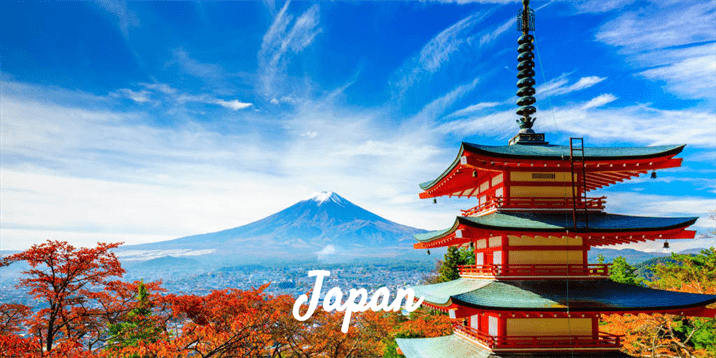
 Japan
Japan
Not been yet
At a glance
- Region
- Eastern Asia
- Capital
- Tokyo
- Population
- 124 million (2024)
- Area
- 377,930 km²
- Languages
- Japanese
- Currency
- Japanese yen (JPY)
- Drives on the
- left
- Calling code
- +81
Visited Still to go Click a pin or country to read more. Zoom with + and −, a double-click or a pinch.
Before you go
Overview
It is an Island state located in East Asia.
By 2018 it recorded a population of 126.5 million and covers an area of 377,915 km2. The capital city is Tokyo. The capital was formerly at Kyoto city which has Buddhist temples, gardens, Shinto shrines and imperial palaces. Kyoto is marked as Japan’s cultural capital.

Mount Fuji, Japan.
History
In 1910, Japan invaded Korea which made it one of the powerful countries in the world. It officially gained independence in 1952 after it signed a peace treaty with San Francisco. It became a member of the United Nations in 1956.
Food & culture
Japanese culture is influenced by their religions, mainly Shinto and Buddhism.
Rice is the major crop grown that is grown in the country. other crops include wheat, barley and soybeans.
Wildlife
The wildlife species living that are found here include monkeys, Manta Rays, sea eagles, Asian bears, whales, Japanese giant salamanders and Hammerhead sharks.
Festivals & events
Gion Matsuri is the most honoured festival in the country and it is celebrated in the month of July for purification of disease-causing agents. Others include Nagasaki Lantern held in Nagasaki to celebrate Chinese New Year, Yuki Matsuri, Kanda Matsuri, Sanja Matsuri and Tenjin Matsuri.
Things to see
Tokyo city maintains traditional architecture like the historic temples to the most modern neon-lit skyscrapers. Other buildings include the opulent Meiji Shinto Shrine with a towering gate and surrounded by woods and the Imperial Palace surrounded by public gardens.
Japan’s Museums like Tokyo National Museum, Edo-Tokyo Museum, National Museum of Western Art, Mori Art Museum and many others display classical art and Japanese culture and history.
Some of the interesting places to visit include Mount Fuji an active volcano which is the highest point in the country. It is considered as a sacred mountain and hiking there is very popular.

The Kinkaku Temple (Golden Pavilion) in Kyōto, Japan, was originally built in the 15th century; the present structure dates to the 1950s.
Interesting facts
Japan has the third-largest economy in the world.
Tokyo is the world’s largest and most populated city. The city is known for the manga, video games, anime and electronics at Akihabara which glows at night providing an appealing scene to see.
It is the origin of Sushi, which is known as a Japanese dish, comprising salted or sugared vinegared rice served with seafood, vegetables and fruits.
It is also famous for the fine traditional arts it maintains, and performance of activities like tea ceremonies, calligraphy and flower arranging.
Japanese is the official language in Japan and the major religions are Buddhism and Shintoism.
Neighbours
Japan has no land borders with other countries.