
 Libya
Libya
Not been yet
At a glance
- Region
- Northern Africa
- Capital
- Tripoli
- Population
- 7.4 million (2024)
- Area
- 1,759,540 km²
- Languages
- Arabic
- Currency
- Libyan dinar (LYD)
- Drives on the
- right
- Calling code
- +218
Visited Still to go Click a pin or country to read more. Zoom with + and −, a double-click or a pinch.
Before you go
Overview
Libya is a North African country. Most of it is desert and it has abundant oil. Majority of the population has settled at the coast and the mainland at Tripoli which is the capital city.
The country has got three historical provinces; at the northwest is Tripolitania, at the east Cyrenaica and at southeast Fezzan.
The Romans invaded Libya in 74 BC and took control of the land for decades. Later, in AD 643, it was invaded by the Arabs who spread the Islam religion. In the 16th century, the country became part a section of the Ottoman Empire which united the three provinces of Tripolitania, Cyrenaica and Fezzan into one government. Italy then took control of the land in 1911 from the Ottoman Empire, resulting in a twenty years revolt that was led by Omar al-Mukhtar. The Italians were removed in 1942 by affiliates in Libya causing division of the country between the British and French.
Libya later gained independence from Britain and French with King Idris al-Sanusi. The king was overthrown by Muammar Gaddafi in a coup in 1951. Gaddafi ruled for four decades until he was overthrown and killed on 20th October 2011 after an Arab revolution.

Remains of the Roman amphitheatre at Leptis Magna.
Libya has a size of 1.8 million squared kilometres. It is the fourth largest in Africa and as of 2020, it had a population of 6.871 million.
The official language is Modern Standard Arabic.
The education system comprises of primary school learning for children from age six to fifteen and secondary learning for students from fifteen to eighteen years old.
The predominant religion is Sunni Islam.
The most popular sport is football.
The country’s largest export is petroleum products. The agricultural products are mainly fruits and vegetables like dates, almonds, grapes, watermelon and citrus fruits. However much of the food is imported because the climate is dominated by the hot arid Sahara.
Libya is bordered on the north by the Mediterranean Sea, on the east by Egypt, on the southeast by Sudan, on the south by Niger and Chad and on the west by Tunisia and Algeria.
History
Libya was settled by Phoenicians, Greeks and Romans, then ruled by Arabs and Ottomans before Italian colonisation in 1911. Muammar Gaddafi ruled from 1969 until 2011.
Food & culture
Couscous, bazeen (a barley dough with stew) and spiced lamb dishes are traditional.
Wildlife
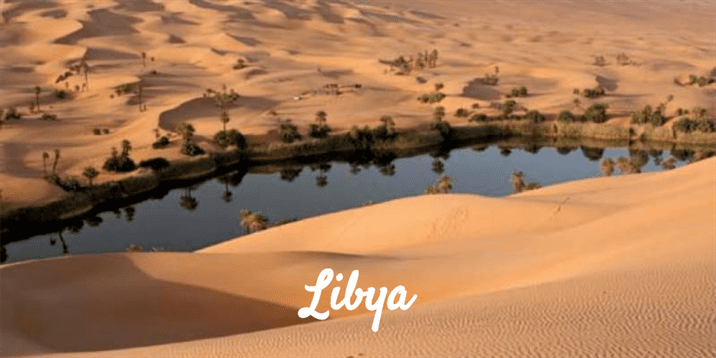
Most of the country is Sahara desert, home to fennec foxes, addax and dorcas gazelles.
Festivals & events
The Ghadames Festival celebrates the desert town's Tuareg and Berber heritage.
Things to see
The Roman cities of Leptis Magna and Sabratha, the Greek ruins of Cyrene and the old town of Ghadames.
Interesting facts
Leptis Magna is one of the best-preserved Roman cities in the world.
Neighbours
My Bucket List goals in Libya
None on the list yet. Got a suggestion? Email Dan.