
 Chad
Chad
Not been yet
At a glance
- Region
- Middle Africa
- Capital
- N'Djamena
- Population
- 20.3 million (2024)
- Area
- 1,284,000 km²
- Languages
- Arabic, French
- Currency
- Central African CFA franc (XAF)
- Drives on the
- right
- Calling code
- +235
Visited Still to go Click a pin or country to read more. Zoom with + and −, a double-click or a pinch.
Before you go
Overview
Chad is a landlocked country in north-central Africa. Its capital city is N’Djamena, previously called Fort Lamy, which is 1000 miles by road from coast ports of western Africa.
It had a population of 15.946 million as of 2019.
Though it is the fifth largest country in Africa, the northern part of the country is covered by the Sahara desert.

Cattle along a road in the countryside.
Subsistence agriculture is the backbone of the majority of the population. The people there keep cattle and also plant cotton in the south for export. People living at Lake Chad take part in fishing. Subsistence crops planted are grains, oilseeds, tubers, and vegetables. Major staples in the local diet majorly contain millet and sorghum.
Chad’s national dish is peanut and squash stew.
Chad was a French colony in the early 1900s before gaining independence in 1960, with the first president being Francois Tombalbaye.
In 1963, political parties were banned triggering Muslim opposition in the north. The opposition was led by the Frolinat rebel group and it later grew into a guerilla war.
In 1973, French troops suppressed the Muslim insurgency. Then, in 1977, Libya took over Aouzou strip in the north and dispatched troops to support President Goukouni Oueddei.
In 1990, Idriss Deby took over power after toppling President Hissene Habre. In 2011, a presidential election that the opposition avoided made Idriss Deby the winner. Debby was won a fifth term as president in the 2016 polls.
The country’s principal sport is football, followed by basketball, athletics, boxing, and martial arts.
The official language is French and the primary religions are Islam and Christianity.
Chad is bordered to the north by Libya, to the east by Sudan, to the south by the Central African Republic, to the west by Nigeria, Niger, and Cameroon.
History
Chad was home to powerful Sahelian empires such as Kanem-Bornu before French colonisation. It became independent in 1960 and has since experienced long periods of civil war and instability.
Food & culture
Boule, a millet or sorghum dough, is eaten with sauces made from okra, peanuts or dried fish. More than 100 languages are spoken, with French and Arabic official.
Wildlife
Zakouma National Park has seen a remarkable recovery of its elephant herds and is home to lions and huge flocks of birds.
Festivals & events
Independence Day is 11 August, and the Gerewol festival of the Wodaabe people takes place after the rainy season.
Things to see
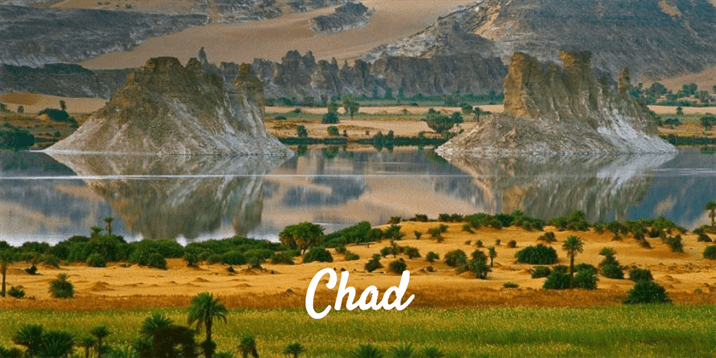
Zakouma National Park, the Ennedi Plateau's rock formations and arches, and the lakes of Ounianga.
Interesting facts
Lake Chad has shrunk dramatically since the 1960s. The Ennedi Massif and the Lakes of Ounianga are both UNESCO sites.
Neighbours
My Bucket List goals in Chad
None on the list yet. Got a suggestion? Email Dan.