
Dive With Whale Sharks
Still to do
Jump off the boat as a spotted shark the length of a bus glides towards you, its mouth wide open.
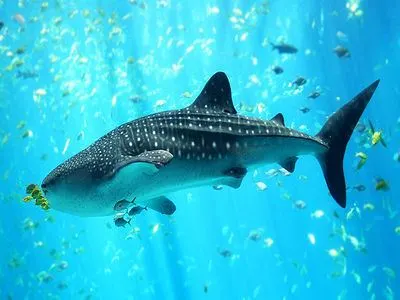
The adventure
The spotter plane circles, the radio crackles, and the skipper swings the boat round. "Get ready." You sit on the stern in mask and fins, and on the signal you slide into the water and look down. At first there's only blue, then a huge shape materialises, checked with white spots and stripes, its mouth a metre-wide gap sieving plankton from the sea.
It moves slowly, but you'll still be kicking hard to keep up alongside. Remoras cling to its belly, a tail fin taller than you sweeps from side to side, and the whole animal seems almost unaware of your existence. The world's biggest fish is entirely harmless to people, and after a few minutes it sinks gently into the deep. Everyone climbs back aboard talking at once.
Why it’s epic
- Whale sharks are the largest fish in the world, with the biggest reliably measured at around 18 metres.
- Each shark's pattern of spots is unique, and researchers use photos to identify individuals.
- At Ningaloo Reef, a UNESCO World Heritage Site, spotter planes guide boats to the sharks.
- Off Isla Holbox and Isla Mujeres in Mexico, hundreds can gather at once in summer.
What it is
Whale sharks are the largest fish in the sea and feed on plankton.
How to do it
Ningaloo Reef in Australia (March to July), Isla Holbox in Mexico (June to September) and Donsol in the Philippines are popular.
Top tip
Avoid places where the sharks are fed to attract them.
Need to know
- Seasons vary by place, from roughly March to July at Ningaloo and June to September in Mexico, so plan around them.
- Avoid feeding sites such as Oslob in the Philippines, where hand-feeding changes the sharks' natural behaviour.
- Keep your distance, never touch them and stay clear of the tail; operators brief you on local rules.
Make it happen
Some of these are affiliate links: if you book through them I may earn a small commission, at no extra cost to you. More about this.
Why it’s on my list
Whales or sharks? Because of their size, many would and have said that they are whales. But they aren’t whales at all. They’re sharks. And in spite of their thousands of teeth, they’re no threat to humans – they eat plankton & krill albeit by the ton.
To see whale sharks you need to be prepared to travel, unless you are lucky enough to live in one of the below locations, and pay attention to when you can see them , where. Whale sharks like to travel. In fact, they spend most of their lives on the move. Although much is still unknown about these gentle giants, it is thought that whale sharks are solitary creatures that migrate according to where the food is to be found.
Did you know:
Whale sharks have up to 3,000 teeth, but as filter fish, they don’t eat with their teeth. So what, you ask, are they good for? Not much really, at least as far as scientists know. Cant see them in the picture? Thats because each one is about as large as a match tip.
Comments