
Bucket List / Experience Goals
Perform A HALO Skydive
Still to do
Step out at around 30,000 feet, higher than Everest, on bottled oxygen and fall for twice as long as a normal skydive.
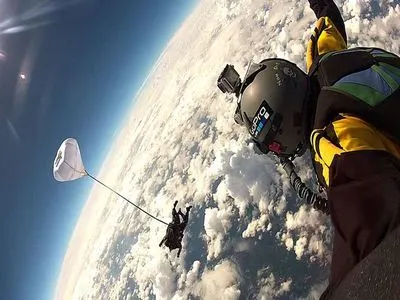
The adventure
The ramp opens at roughly 30,000 feet, above the height of Everest's summit, and the air that floods in is thin enough to knock you out within a minute and cold enough to frost your goggles. You've been breathing pure oxygen since take-off to flush nitrogen from your blood, and now you jump on your own oxygen supply, wrapped in thermal layers, the horizon curving away under a dark blue sky.
Then you go. In air this thin you accelerate faster than on any ordinary jump, and freefall lasts around two minutes instead of one. The roar is enormous, the cold bites through your gloves and the ground seems to take an age to grow. Only a few thousand feet above it do you finally deploy, and the sudden quiet under canopy feels like arriving in another world. This is the technique military parachutists train for, and only a handful of civilian drop zones offer it.
Why it’s epic
- Exit altitudes of 25,000 to 30,000 feet, roughly double the 10,000 to 15,000 feet of a standard skydive.
- Around two minutes of freefall, about twice as long as a normal jump.
- Temperatures at exit can be colder than minus 30°C, even on a summer day.
- The same principle behind record-breaking stratospheric jumps by Felix Baumgartner in 2012 and Alan Eustace in 2014.
What it is
HALO means high altitude, low opening: jumping from very high altitude with oxygen.
How to do it
Specialist operators offer HALO jumps for licensed skydivers.
Top tip
You'll need oxygen training first.
Need to know
- Solo HALO jumps are for experienced, licensed skydivers; a few operators offer high-altitude tandem jumps for beginners.
- Expect a hypoxia and oxygen-equipment briefing, a medical declaration and strict weather limits on the day.
- Do a standard tandem first so you know you enjoy freefall before paying for the big one.
- Check your travel or activity insurance specifically covers high-altitude skydiving.
Make it happen
Why it’s on my list
HALO stands for High Altitude Low Opening. In essence jumping out of a plane from above 28,000 feet plus (the norm is around 12 – 15,000 feet). Due to the high altitude the temperature is somewhere around 25 to 35 degrees below zero. Without oxygen, you would likely be unconscious pretty quickly.
There are a few extreme examples recently of HALO skydiving – most famously Felix Baumgartner, followed by Alan Eustace.
After flying to an altitude of 39,045 meters (128,100 feet) in a helium-filled balloon, Felix Baumgartner completed a record breaking jump from the edge of space. Felix reached a maximum of speed of 1,357.6 km/h or 843.6 mph before being slowed by the atmosphere during his 4:20 minute long free fall. The 43-year-old Austrian skydiving expert also broke two other world records (highest free fall and highest manned balloon flight), leaving the one for the longest free fall to project mentor Col. Joe Kittinger.
Jumping from a balloon at 135,890 ft (41,419 m) above Roswell, New Mexico, Eustace also set new world records for vertical speed and free fall distance.
Eustace and the StratEx (Stratospheric Explorer) program team also took a slightly different approach. Rather than being protected from the environment by a custom-built fibreglass pressurised capsule like Baumgartner, Eustace rose to the stratosphere in a pressure suit dangling from a helium-filled scientific balloon.
The ascent took two hours and seven minutes, with Eustace spending around half an hour enjoying the view before cutting himself free of the balloon at 9:09 MDT on October 24 and arriving back on solid ground 14 minutes and 19 seconds later.
Eustace reached a maximum speed of 1,323 km/h or 822 mph. He covered 123,414 ft (37,607 m) in just four minutes and 27 seconds.
Comments